Why Your Business Needs Biology, Not Battle Plans
In the business boardroom, we love war metaphors. We launch “campaigns,” capture “targets,” and execute “tactical maneuvers.”
We treat the market like a battlefield to be conquered and our organizations like machines to be re-engineered.
Yet, despite all this martial precision, 70% of change initiatives fail.
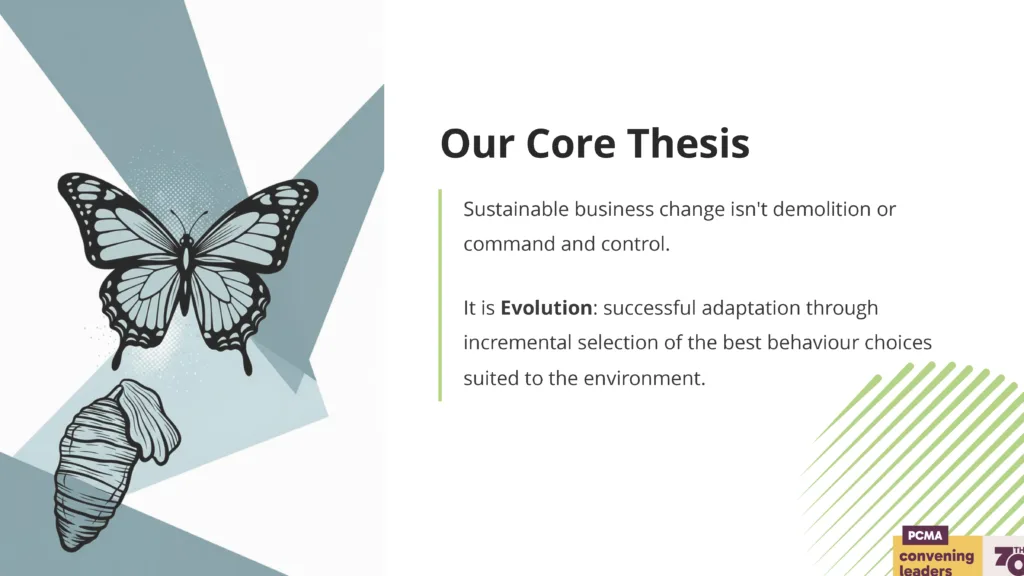
Why is the casualty rate so high? The answer lies in a fundamental category error. Your organization is not a machine to be fixed, nor a battlefield to be won. It is a complex, living organism. When you try to “shock” a biological system into compliance, it doesn’t just break; it fights back.
To survive the future, we must trade the General’s command for the Ecologist’s insight.
Here is the science behind why traditional change fails, and the evolutionary frameworks you can use to succeed.
The Biology of Resistance: Why “Business Revolution” Fails
We often romanticize the idea of a “Revolution”, a sudden, sweeping restructuring or a massive “rip-and-replace” of technology. But biology tells us that revolutions are traumatic events.
1. The Homeostatic Snap-Back
Biological systems are designed to maintain homeostasis, a stable internal state. When a human body experiences sudden shock (like extreme cold), it shivers to generate heat and return to normal.
Organizations behave the same way; we seek alignment of thoughts and standardization of process. When leaders introduce massive, disruptive change (Revolution), the organizational “immune system” activates. The culture instinctively resists the shock to protect its stability, often snapping back to old behaviors the moment the pressure is released.
2. The Cortisol Corridor vs. The Dopamine Loop
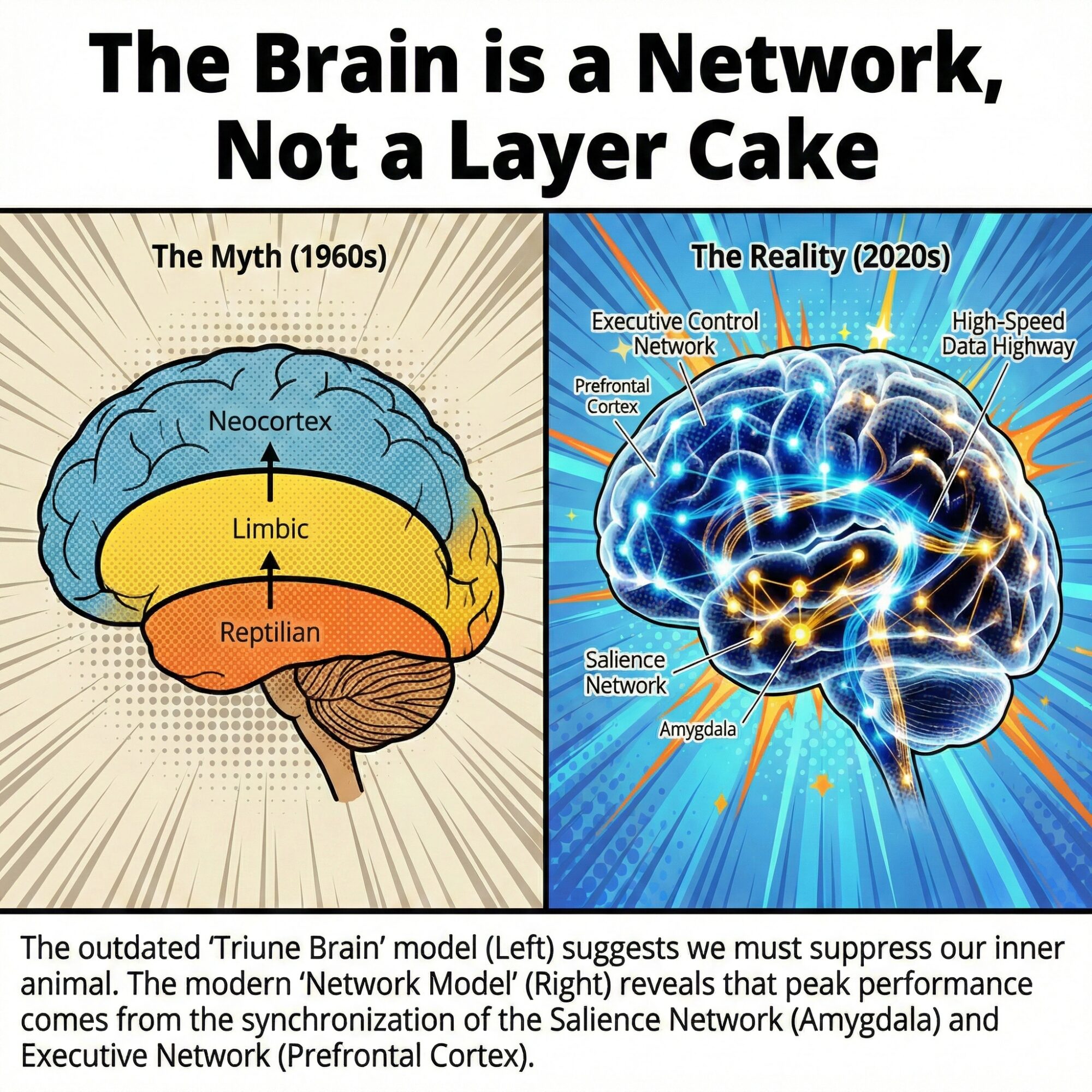
Neuroscience plays a critical role in how your team perceives change.
- The Cortisol Spike (Revolution): Disruptive, high-stakes change triggers the amygdala, flooding the brain with cortisol (the fear hormone). This creates a “fight or flight” response, leading to anxiety, risk aversion, and resistance.
- The Dopamine Loop (Evolution): Evolutionary change relies on micro-adaptations, small, incremental improvements. Achieving these small wins releases dopamine (the reward hormone). This chemical reward reinforces the behavior, creating a cycle of engagement and momentum rather than fear.
The Evolutionary Alternative: Survival of the Most Responsive
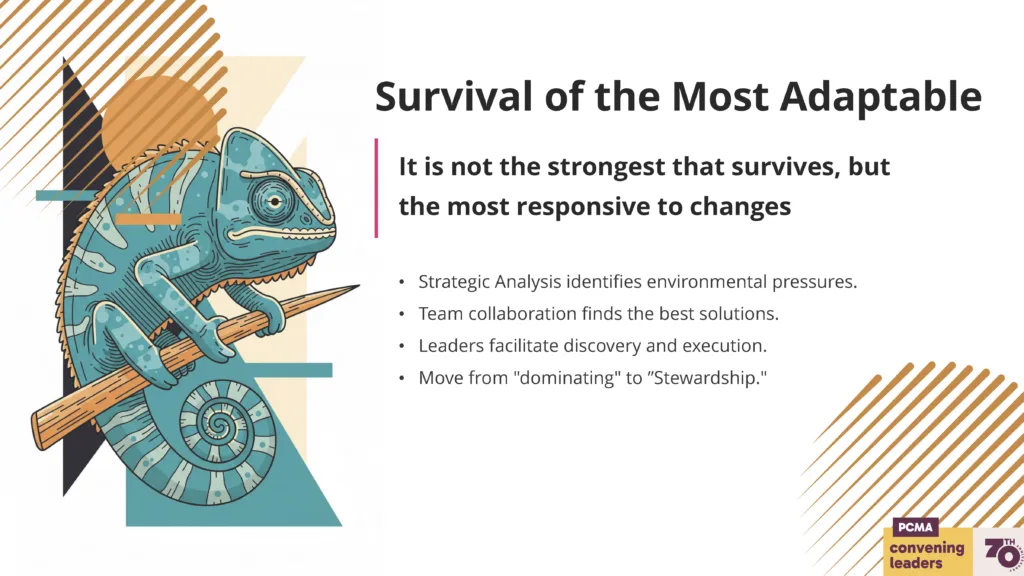
Darwin is often misquoted as saying “survival of the fittest” means survival of the strongest. In reality, survival belongs to the most responsive.
In business, this means moving away from “dominating the market” (strength) to “fitting the market” (adaptability).
| Feature | The Revolution Model (War) | The Evolutionary Model (Biology) |
| Pace | Sudden / Shocking | Continuous / Iterative |
| Driver | Crisis / Authority | Adaptation / Necessity |
| Metric | “The Most Dominant Win” | “The Most Adaptable Win” |
| Outcome | Destabilization | Resilience & Growth |
3 Actionable Frameworks to Engineer Business Evolution
How do we move from philosophy to practice? We must replace “Command and Control” with “Sense and Respond.” Here are three actionable approaches from the PCMA Institute curriculum to help you lead like an Ecologist.
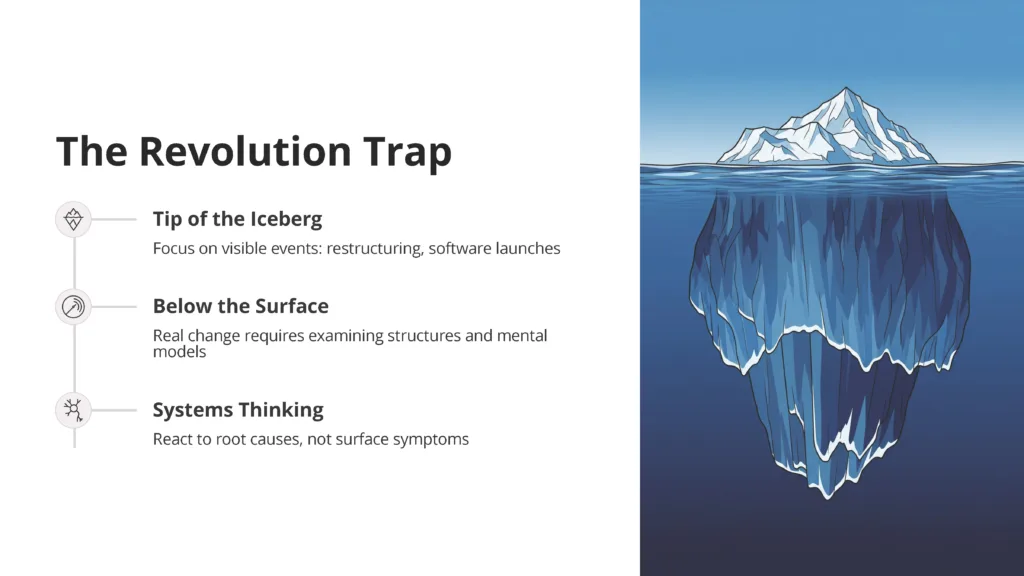
1. Diagnose with Systems Thinking (The Iceberg Model)
Before you change anything, you must understand what lies beneath. In the Leading with Strategic Influence course, we use the Iceberg Model to avoid the “Event Trap.”
- The Trap: Reacting only to visible events (e.g., missed targets, a competitor’s launch).
- The Fix: Look below the waterline. Identify the Patterns (trends over time), Structures (policies/resources), and Mental Models (beliefs) that drive those events.
- Action: Don’t just fire the underperforming team (Event). Ask what structural incentives or cultural beliefs (Mental Models) caused the underperformance.
2. Experiment with the PDCA Cycle
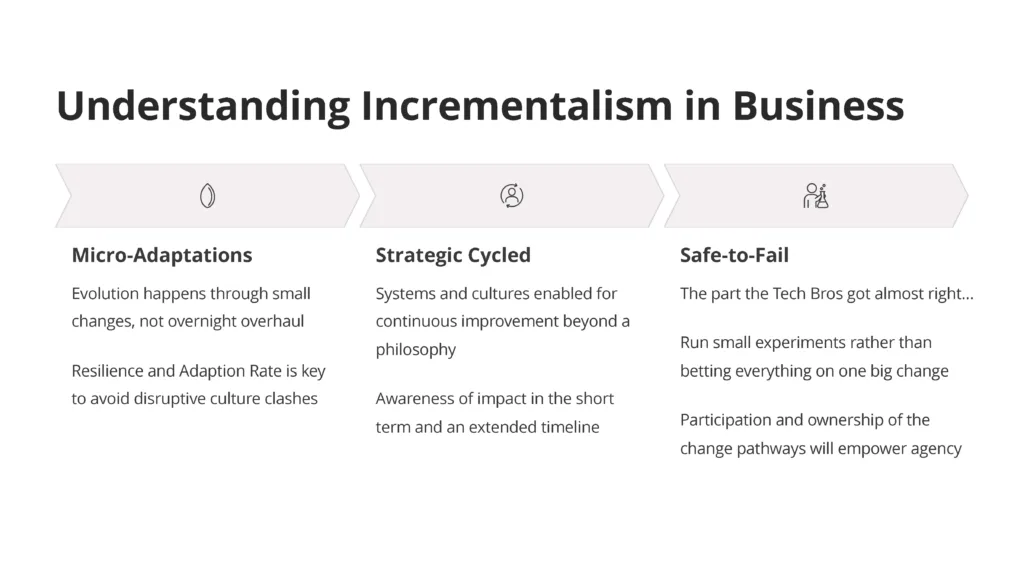
Evolution is just a series of successful experiments. Instead of betting the farm on one massive strategy, adopt the philosophy of Kaizen (continuous improvement) using the PDCA Cycle:
- Plan: Identify a specific environmental pressure.
- Do: Run a “safe-to-fail” experiment. This is a small-scale trial that won’t destroy the company if it doesn’t work.
- Check: Analyze the data. Did the organism adapt successfully?
- Act: If yes, standardize the change (encode it into the DNA). If no, learn and pivot.
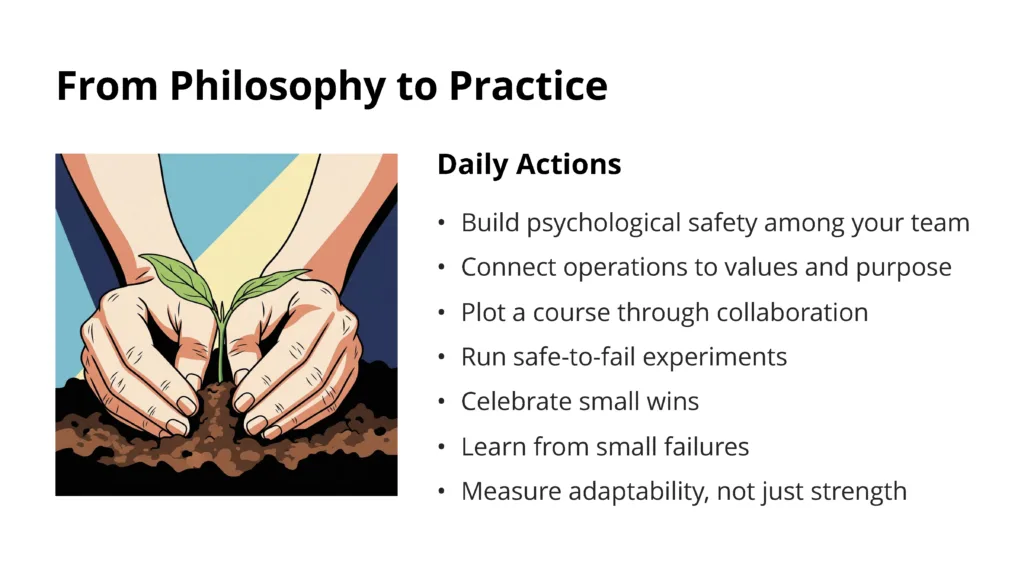
3. Nourish with Psychological Safety
If you want your organization to evolve, you need mutations, new ideas, and behaviors. But in a fear-based environment (high cortisol), people hide mistakes and suppress new ideas to stay safe.
- The Leader’s Role: Your primary job is to create Psychological Safety. This is the nutrient-rich soil that allows “good mutations” to survive without fear of premature criticism.
- Action: Celebrate “smart failures” that come from testing new ideas. This signals to the “ecosystem” that innovation is safe.
The Genetic Code of Legacy in Business
Command-and-control maneuvers die when the General leaves the field. But evolutionary change rewrites the cultural DNA of your organization. It creates a legacy that survives in the gene pool long after your tenure.
We are not just hitting Q4 targets; we are selecting the genetic traits that will define our company for the next decade.
Ready to Evolve?
Shifting from a “War” mindset to a “Biology” mindset is simple to understand but difficult to master. It requires specific tools to diagnose systems, build trust, and execute continuous improvement.
Take the next step in your evolution:
- Join the next cohort: Enroll in the PCMA Institute’s “Leading with Strategic Influence” certificate course to master tools like Systems Thinking and the Trust Equation.
- Stay connected: Sign up for a seat at the Strategy Table to access exclusive workshops and field guides to help you engage your teams and bring out their best.
Nature doesn’t rush, yet everything is accomplished. Let’s evolve.