Welcome to your digital toolkit for mastering the ghost in the machine. This site serves as a follow-up to our session, helping you understand how ancient “factory settings” sabotage modern decision-making. It is not your fault when a glitch happens; it is biology. But it becomes your fault if you do not recognize it.
The Brain Management Team
Leadership today demands more than just high-level intelligence; it requires radical intellectual humility. This guide is your toolkit for “cleaning the lens” through which you evaluate decisions, lead teams, and manage organizational change.
Self-awareness is not a soft skill, it is your greatest strategic advantage.
Modern neuroscience reveals our brains as magnificent, complex systems. However, we are running on software that has not been properly updated since the Ice Age.
These specialized regions govern our daily leadership behaviors:
The Amygdala (Head of Security): Perpetually panicked, overriding rational thought for immediate safety.
The Prefrontal Cortex (CEO): Responsible for logic and executive function, but often shouted down by the amygdala.
The Basal Ganglia (Head of Operations): Manages habit formation and neural entrenchment, making biases feel like common sense.
Section 1: Evaluating & Decision-Making
How we process information and reach conclusions.
Brain Glitch
What is it?
The Leader’s “Circuit Breaker” Question
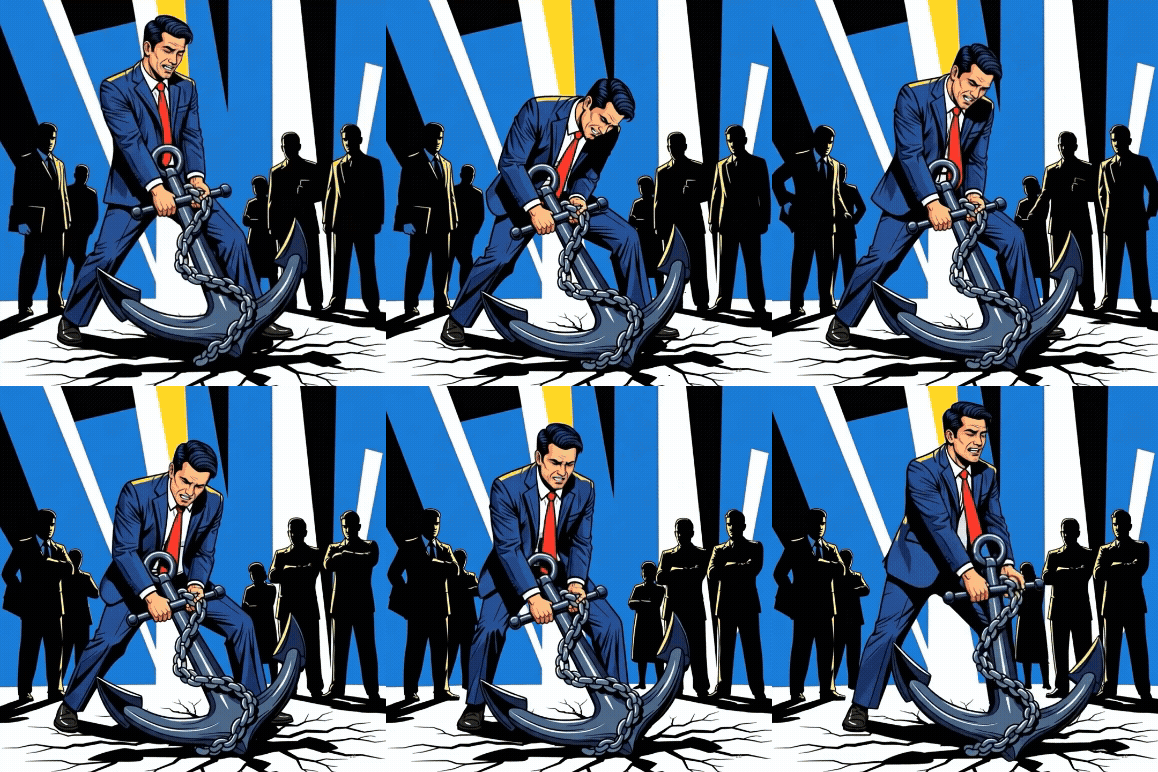
Anchoring Effect
Relying too heavily on the first piece of information offered when making decisions.
“If I hadn’t heard that initial number or opinion, where would my ‘logic’ land me?”
Confirmation Bias
Searching for or interpreting information in a way that confirms your pre-existing beliefs.
“What are three pieces of evidence that could prove my current hypothesis is wrong?”
Authority Bias
Attributing greater accuracy to an authority figure’s opinion, regardless of content.
“Am I inviting dissent, or am I accidentally signaling the ‘correct’ answer too early?”
Leadership Ritual: Speak Last. In meetings, have the most junior team members share their thoughts first to avoid “Anchoring” the room to your “Authority.”
Cautionary Tale: Kodak’s Moment of Madness
Kodak invented the digital camera in 1975 but buried it to protect their profitable film business.
The glitch was Confirmation Bias; executives sought data confirming film’s longevity while dismissing the digital future.
Section 2: Team Dynamics
How we perceive our people and their performance.
Brain Glitch
What is it?
The Leader’s “Circuit Breaker” Question
Halo & Horn Effect
Letting one positive or negative trait color your entire perception of a person’s competence.
“Am I judging this person’s total value based on one specific win/loss, or their overall track record?”
Fundamental Attribution Error
Blaming others’ failures on their character, while blaming your own failures on external circumstances.
“If I were in their exact shoes with their same resources, what external factors might have caused this outcome?”
Automation Bias
Over-relying on automated systems and ignoring human intuition or contradictory data.
“If the AI/Algorithm was completely offline today, would this decision still pass the ‘common sense’ test?”
Leadership Ritual: The Context Check. Before a performance review or feedback session, explicitly list three external factors that may have influenced the outcome you are discussing.
Cautionary Tale: Volkswagen’s Dieselgate
VW created a “defeat device” to cheat emissions tests when performance goals were unachievable.
The glitch was Groupthink and Confirmation Bias, where a high-pressure culture silenced dissent.
Section 3: Understanding Change & Time
How we interpret patterns and project the future.
Brain Glitch
What is it?
The Leader’s “Circuit Breaker” Question
Sunk Cost Fallacy
Continuing an endeavor because of previously invested resources even when it no longer makes sense.
“If we were starting this project from scratch today with zero prior investment, would we choose to fund it?”
Gambler’s Fallacy
The belief that if something happens more frequently than normal, it will happen less frequently in the future.
“Are we betting on a ‘win’ just because we’ve had a run of ‘losses,’ or is there a strategic reason for success?”
Clustering Illusion
The tendency to see “streaks” or patterns in random data where none actually exist.
“Is this a genuine trend we can replicate, or are we just seeing shapes in the clouds?”
Leadership Ritual: The Pre-Mortem. Before launching a new phase of a project, gather the team and say: “It’s one year from now and this project has failed. What went wrong?” This bypasses the clustering illusion and optimism bias.
Cautionary Tale: The Concorde’s Costly Elegance
Public money was poured into the supersonic jet long after it was clear it would never be profitable.
The glitch was the Sunk Cost Fallacy; it became psychologically impossible to cut losses due to vast past investments.
🚀 3 Habits of the High-Impact Leader
Self-awareness is the ultimate competitive advantage. By acknowledging where your brain is prone to detour, you empower yourself to lead with greater clarity.
Celebrate “Being Wrong”: When a leader says, “I’ve changed my mind based on new data,” they give the team permission to be objective rather than defensive.
Assign a Devil’s Advocate: In every major decision-making meeting, appoint one person whose job is to find the “glitches” in the plan. Rotate this role so it doesn’t become personal.
Audit the “Why”: Periodically ask, “Why do we do it this way?”. If the answer is “Because we always have,” you are likely dealing with Status Quo Bias.
Ready to build more resilient, rational, and human-centric workplaces?
Explore the wider ecosystem of resources, books, and Field Guides at Strategy Table.
Sign up for a seat at the table to download a copy of “A Leader’s Diagnostic Cheat Sheet”
CONTENT LOCKED – LOG IN TO VIEW AND DOWNLOAD THE PDF
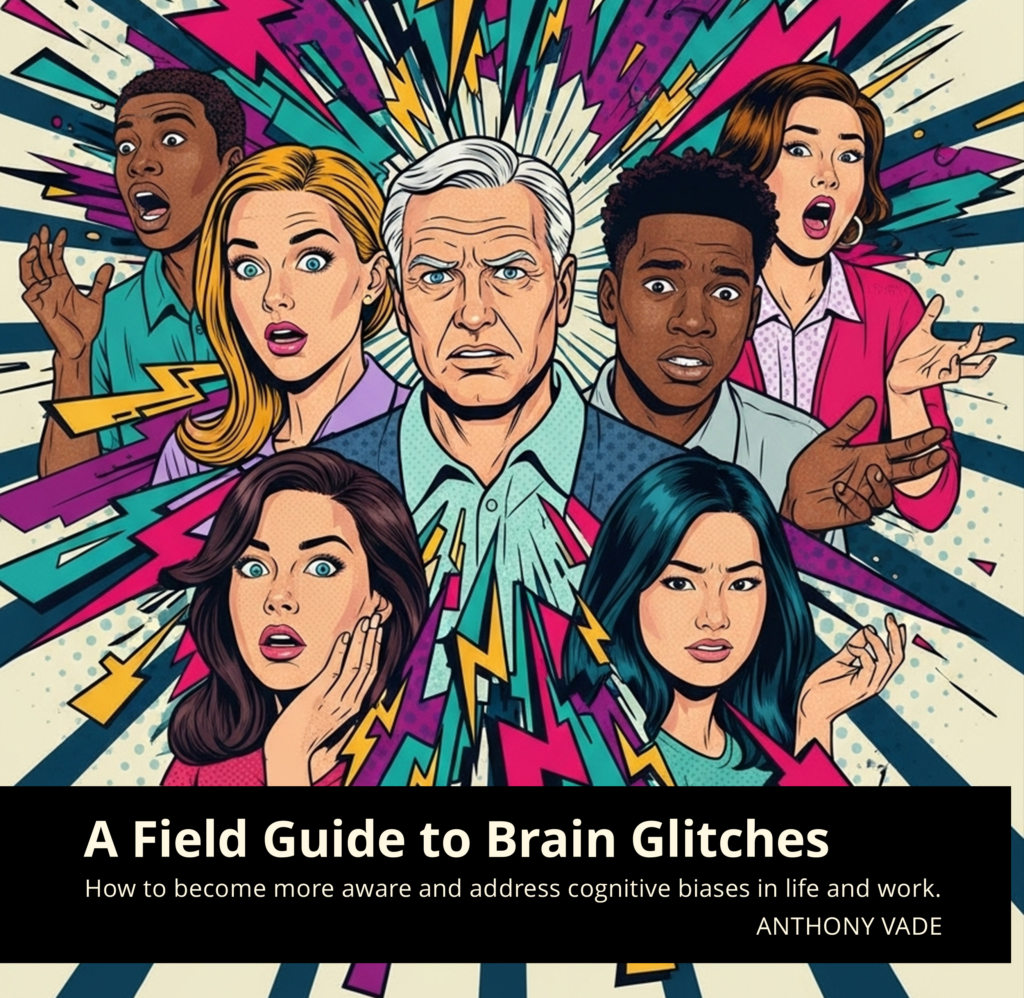
Get your copy of A Field Guide to Brain Glitches today
Have you ever wondered why brilliant teams make disastrous decisions?
The scary truth is that the same “glitchy” mental software that led to the spectacular collapse of giants like Kodak and Blockbuster is running in your head right now. Your brain is a marvel, but it’s also a lazy shortcut-taker, operating on ancient programming better suited for the savannah than the modern boardroom. These shortcuts, or cognitive biases, are the invisible architects behind bad judgments and failed projects.
This guide takes you into the corporate crypt to show how biases like Confirmation Bias, the Sunk Cost Fallacy, and Groupthink led to predictable catastrophes. But this is more than a collection of cautionary tales; it is a diagnostic manual for intellectual self-defense Drawing on decades of experience advising Fortune 500 leaders and the revolutionary work of psychologists like Amos Tversky and Daniel Kahneman, this book maps out the 50 most common glitches in our thinking machine.
Inside, you’ll discover a practical de-biasing toolkit, complete with actionable questions to challenge your own thinking and that of your team. Learn to spot these patterns before they derail your strategy.
Don’t let your brain’s factory settings sabotage your success. Arm yourself with this guide, and start making clearer, more objective decisions today.