
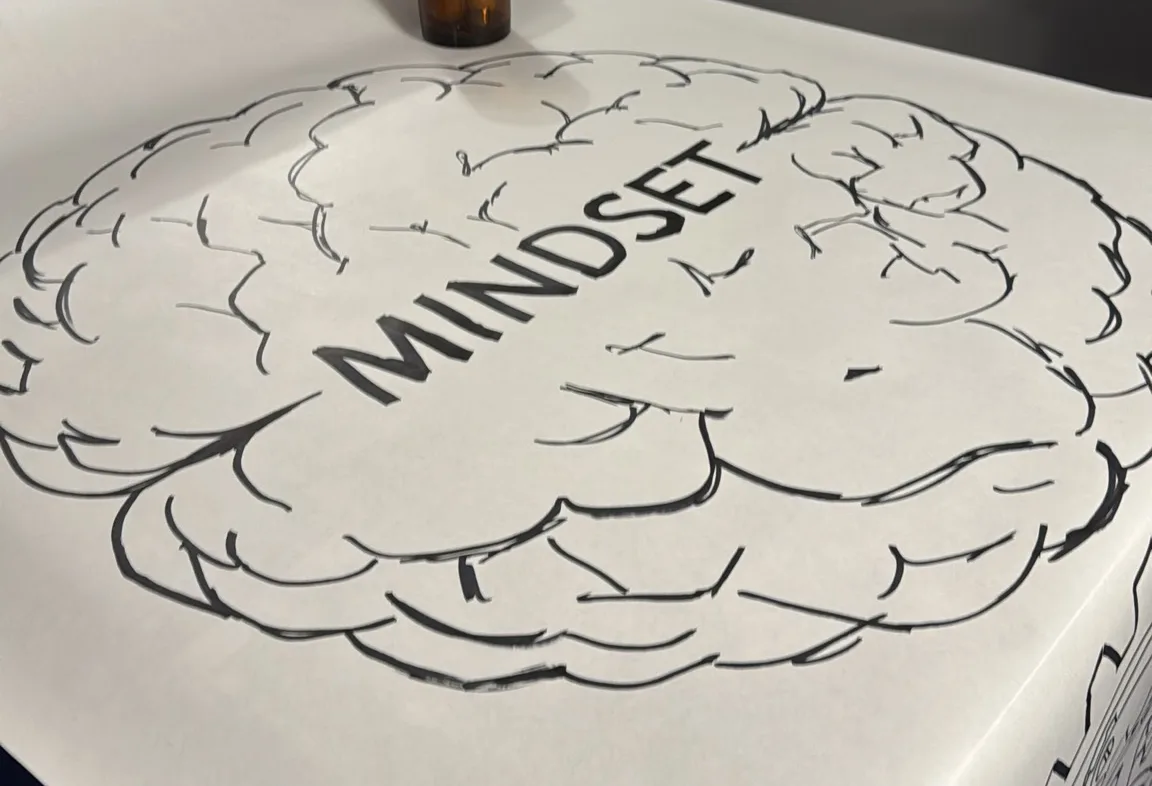
A Month of Creative Disruption, Cognitive Clarity, and Non-Linear Strategy
Every November, executive leadership teams run into the same predictable rhythm.
Calendars become jammed with year-end forecasting, Q4 deliverable sprints, and iterative 2027 roadmapping sessions. Strategy decks swell with spreadsheets, risk matrices, and competitive benchmarks. Teams push harder, meetings run longer, and the demand for operational certainty reaches a fever pitch.
Yet by the time most organizations finalize their linear plans, they reach the same conclusion as their competitors: safe, incremental parity.
When everyone analyzes the same historical data using the same software models, originality is systematically bred out of the equation. Meanwhile, the cognitive toll of endless screen time, continuous context-switching, and metric fixation leaves senior leadership teams depleted just when they need visionary clarity the most.
True competitive advantage does not come from running another spreadsheet optimization loop. It demands divergent thinking, tactile problem solving, and the courage to approach corporate architecture with an artist’s mindset.
This month, Strategy Table is tearing up the conventional business playbook.
Throughout November, we are publishing a daily, 23-part editorial curriculum exploring how contemporary studio practices, sensory environments, and non-linear cognition unlock disruptive innovation and safeguard executive wellbeing.
The Four Weekly Thematic Arcs
Rather than offering disconnected productivity tips, the November series is structured into four progressive phases, moving from executive mindset shifts to deep neurobiological resets, strategic abstraction, and cross-functional culture.
Week 1 (Nov 1–6): The Divergent Advantage & Strategic Disruption
We examine why hyper-optimization fails in volatile markets, how dry-erase consensus kills R&D, and why the subcultural DIY ethos of post-punk is the ultimate cure for corporate stagnation.
- Day 01 | Nov 01: The Divergent Advantage: Why Executive Leadership Demands an Artist’s Mindset
- Day 02 | Nov 02: Whiteboard vs. Canvas: De-Risking Corporate Innovation Through Creative Play
- Day 03 | Nov 03: Beyond the Algorithm: Why AI Acceleration Makes Human Creative Intuition Indispensable
- Day 04 | Nov 04: From Punk to Pivot: Embracing Creative Disruption and Anti-Fragile Business Thinking
- Day 05 | Nov 05: The DIY Imperative: How the Punk Ethos Cures Corporate Bureaucracy
Week 2 (Nov 07–13): Cognitive Architecture & Executive Restoration
Burnout is not physical exhaustion; it is cognitive fatigue caused by continuous analytical processing. We dig into the neuroscience of tactile mark-making, non-verbal journaling, and aesthetic rest.
- Day 06 | Nov 07: The Neurological Reset: How Tactile Creative Practice Heals Executive Burnout
- Day 07 | Nov 08: Entering Deep Flow: Reclaiming Attention in a Hyper-Distracted World
- Day 08 | Nov 09: Visual Journaling for Mental Clarity: Decoupling Self-Worth from Metric Productivity
- Day 09 | Nov 10: The Biology of Aesthetic Rest: Why What You Hang on Your Walls Alters Brain Chemistry
- Day 10 | Nov 11: Embracing the Unfinished: Overcoming Executive Perfectionism Through Painting
- Day 11 | Nov 12: The 15-Minute Studio: How to Build a Daily Creative Ritual Without Being a “Painter”
Week 3 (Nov 14–20): Spatial Strategy, Abstraction & Multi-Material Thinking
How do physical workspaces and non-objective art reshape how leaders map systemic bottlenecks? We explore visual problem-solving frameworks that replace slide decks.
- Day 12 | Nov 14: The Studio Effect: How Experiential Visual Environments Drive High-Performance Teams
- Day 13 | Nov 15: Mark-Making as Problem Solving: Visual Thinking Tools for Strategic Roadblocks
- Day 14 | Nov 16: Living with Originals: Why Authentic Human Expression Outperforms Mass-Produced Decor
- Day 15 | Nov 17: The Architecture of Abstraction: Deconstructing Complex Systems Through Non-Objective Art
- Day 16 | Nov 18: Beyond the Brush: Why Poly-Material Experimentation Shatters Strategic Blind Spots
Week 4 & 5 (Nov 21–30): The Polymathic Enterprise & The Analog Resistance
In the final stretch, we address organizational silos, Renaissance thinking in an AI-accelerated economy, the lost power of mental whitespace, and the tactical advantage of stepping away from screens.
- Day 17 | Nov 21: Curation as Identity: How the Art You Collect Shapes the Way You Think
- Day 18 | Nov 22: The Collaborative Canvas: Cross-Disciplinary Art Exercises That Dissolve Corporate Silos
- Day 19 | Nov 23: The Modern Polymath: Resurrecting Renaissance Thinking in an Age of Hyper-Specialization
- Day 20 | Nov 24: Sonic Collage and Controlled Chaos: What Noise and Assemblage Teach Us About Market Turbulence
- Day 21 | Nov 28: The Creative Catalyst: Why High Performers Need a Coach to Unlock Artistic Practice
- Day 22 | Nov 29: Guarding the Void: Mental Whitespace as the Engine of Real Innovation
- Day 23 | Nov 30: The Analog Resistance: Why Tactile Tools Beat Screens for Strategic Problem Solving
How to Follow and Engage This Month
Whether you are a founder leading through market turbulence, a director rebuilding cross-functional trust, or a high performer looking to reclaim focus from constant notifications, this series provides actionable frameworks to reshape your work:
- Follow the Daily Dispatch: Bookmark Strategy Table Pathways or follow our channels like here on Substack as we drop each deep dive every morning at around 9:00 AM Eastern
- Apply the Frameworks with Your Team: Each piece includes hands-on studio exercises, low-tech experiments, and visual tools you can deploy immediately in your next strategy session.
- Experience the Method in Person: Reading about studio thinking is the first step; immersing your leadership team in it is transformative.
Join us at the table this November. It’s time to trade the dry-erase board for the canvas.