
The Orchestration of Systems, Swarms, and Stakeholder Behavior with the Traveling Salesman Problem
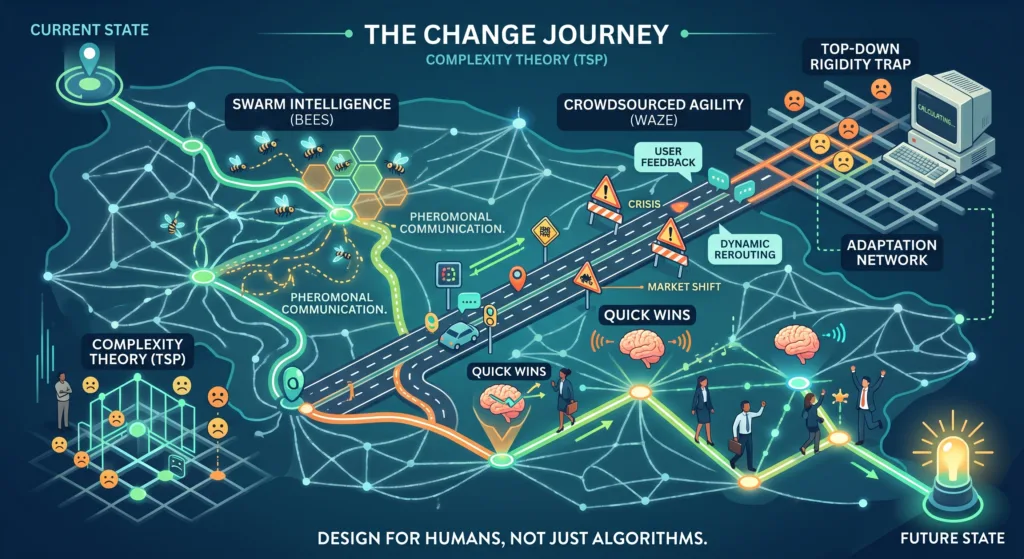
Leading organizational change is hard. Moving a company from its current state to a desired future state across a chaotic map is the absolute essence of change management. You sketch out a vision, draw a straight line from A to B, and assume the organization will simply follow along.
But the pursuit of efficiency is rarely a straight line.
Mathematicians actually have a name for this kind of chaos: the Traveling Salesman Problem (TSP). The puzzle asks a deceptively simple question: “Given a list of cities and the distances between each pair of cities, what is the shortest possible route that visits each city exactly once and returns to the origin city?”.
It sounds easy, but the operational implications are profoundly complex. You simply cannot perfectly calculate every reaction or internal roadblock in advance. Because absolute perfection is unattainable at scale, leaders and algorithms alike must stop merely planning paths and start actively designing change.
Here is how looking at the Traveling Salesman Problem, and the brilliant ways nature and technology solve it, can completely change how you lead your team through a transition.
The top-down trap (and why the “master plan” fails)
Most organizations try to manage change the same way traditional logistics systems handle routing: through massive Big Data predictive analytics. These systems aggregate vast repositories of historical data, traffic patterns, infrastructure demands, and demographics to build highly complex predictive models.
This works admirably when environmental conditions are completely static. The algorithmic “brain” has the luxury of time to compute the optimal pathways from a centralized server.
But the real world is dynamic, chaotic, and subject to instantaneous disruptions. When a sudden crisis hits, systems entirely dependent on massive centralized data processing suffer severe computational bottlenecks.
The takeaway: Much like a rigidly micromanaged corporate team that must ask the CEO for permission to change tactics during a live crisis, a change strategy that must constantly refer back to the top for approval lacks the agility required for survival.
⚠️ The Science of Swarms ⚠️
Fair warning: we’re about to pop the hood and look at the actual science and math for a minute. It’s going to get a bit dense and technical, but stick with us, the payoff for your organizational strategy is worth it.
To understand why traditional planning fails, you have to look at the math. In computational complexity theory, the TSP is classified as an NP-hard problem (Non-deterministic Polynomial-time hard). The mathematical objective is to find a “Hamiltonian cycle”, a cyclic permutation of all nodes that minimizes the sum of traversed edge costs. In a pure brute-force approach, you would calculate every possible permutation. However, due to factorial growth, calculating every conceivable route for just a few dozen cities would take the world’s most powerful supercomputers longer than the current lifespan of the universe.
Because exact mathematical solutions are intractable, algorithm architects looked to social insects, who solve dynamic routing problems every day as an existential imperative.
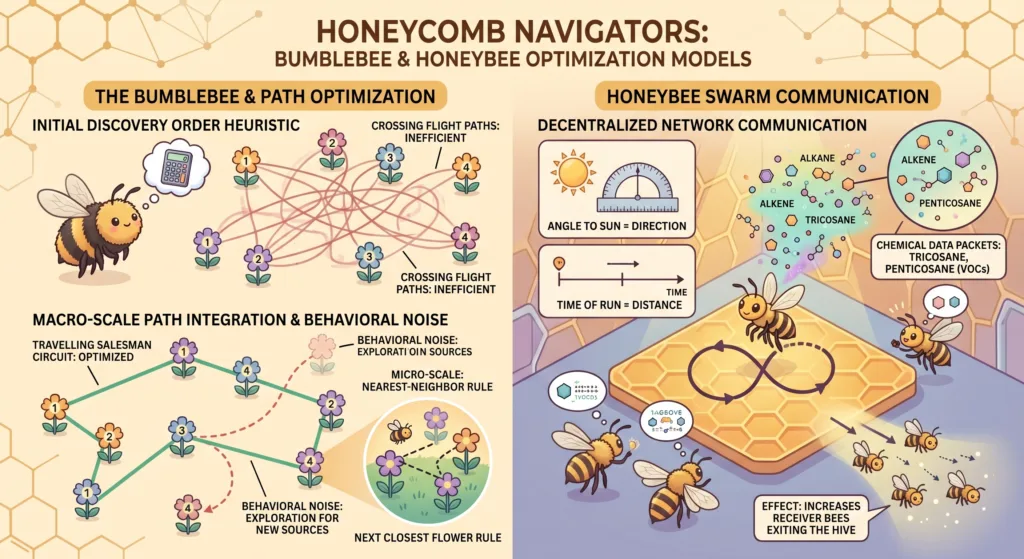
Individual Agility: The Bumblebee Model. Bumblebees lack the cognitive architecture for massive upfront computation. When a bee discovers scattered floral patches, it initially uses a cognitively simple “discovery order” heuristic, flying between patches in the exact chronological order they were found, which frequently results in highly inefficient, crossing flight paths.
- Micro-scale: Within a dense patch, they rely on a simple “nearest-neighbor” rule.
- Macro-scale: Through path integration and spatial memory, they sequentially readjust their routes to develop highly efficient, repeatable primary paths known as “traplines”.
- Behavioral Noise: Crucially, even after finding an optimal trapline, they deliberately maintain secondary routes to explore novel paths. This prevents them from getting trapped in localized optima and allows them to adapt immediately if a food source depletes.
Network Communication: The Honeybee Swarm Honeybees model the profound power of decentralized network communication. They utilize the famous “waggle dance”, a physical figure-eight movement where the duration of the run indicates distance, and the angle relative to the sun dictates direction.
However, modern research shows this is augmented by complex chemical communication. Dancing foragers release specific volatile hydrocarbons (alkanes and alkenes like tricosane and pentacosane). These pheromones act as active, behavior-altering data packets. Higher concentrations correlate with vigorous dances indicating profitable food, actively increasing the number of receiver bees that exit the hive.
The Code: Bee Colony Optimization (BCO). This biological framework proves that optimal routing doesn’t require a central processor. The synthesis of these biological mechanisms birthed the Bee Colony Optimization (BCO) algorithm.
- The system initializes artificial bees that observe digital dances to learn a preferred path, denoted by $\theta$.
- They don’t use a central map; they use a probabilistic State Transition Rule governed by “Arc Fitness” (pheromonal attraction to a peer’s successful path) and “Heuristic Distance” (the biological nearest-neighbor rule).
- Once a cycle is complete, the algorithm uses a “2-opt local search” to mathematically eliminate crossing arcs and refine the route.
- Finally, the digital bee performs a simulated waggle dance to update the global knowledge matrix, completely bypassing the need for central control.
Listen to the crowd (the Waze approach)
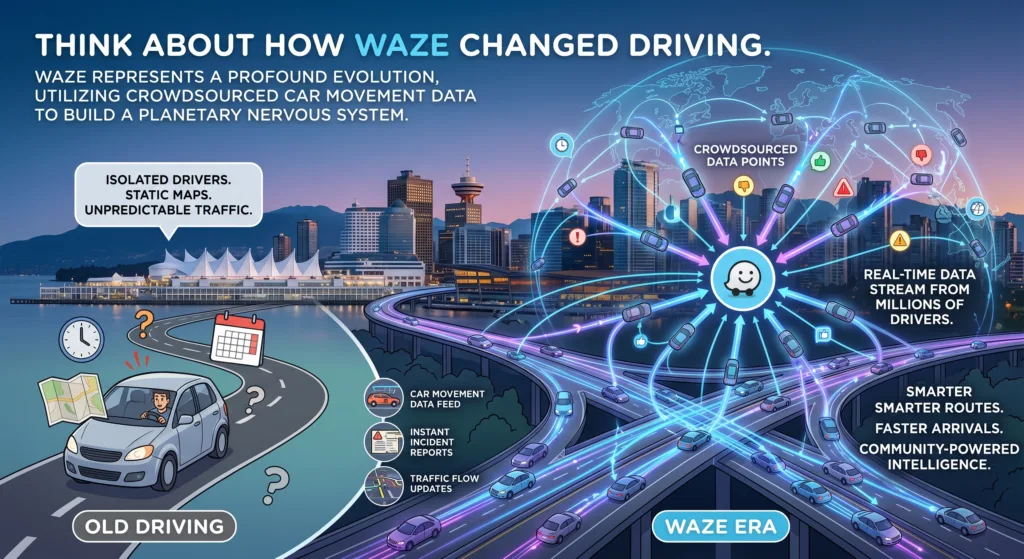
Think about how Waze changed driving. Waze represents a profound evolution, utilizing crowdsourced communication to build a planetary nervous system. It successfully breaks down the barrier between the centralized server and the edge user.
It harvests two tiers of data: passive GPS telemetry from millions of open apps, and active, gamified user reports indicating accidents or hazards. If a flash flood renders a road impassable, this influx of data acts identically to the chemical signaling of a honeybee swarm. The system seamlessly recalculates and redirects approaching vehicles through alternative routes.
The takeaway: Change doesn’t happen without a feedback loop. This dynamic rerouting democratizes traffic management, utilizing decentralized human agents to adapt instantly. If you aren’t listening to real-time feedback from the people doing the work, you’ll drive your team right into a wall.
Psychology always beats the algorithm
An algorithmic solution, no matter how mathematically robust, is functionally obsolete if it completely fails to account for the psychology of the end-user.
When delivery couriers are presented with a perfectly optimized TSP route generated by advanced systems, they frequently and deliberately reject the algorithmic mandate. Why? Because human behavioral psychology reveals that we inherently prioritize “small victories” and “instant gratification” over absolute, global efficiency. Couriers systematically prioritize visiting the nearest available locations first, rather than following a long stretch that defers the reward of a completed delivery.
The takeaway: To foster actual adoption, a progressive approach to systems design acknowledges that human operators will invariably reject routes that defer psychological gratification. Your change journey must include quick wins. If your team doesn’t feel a sense of progress, they’ll resist the change.
The bottom line: Design for brains, not algorithms
Let’s bring this all together. The Traveling Salesman Problem teaches us a humbling but necessary lesson: you cannot brute-force your way through complexity. When you try to map every single step of an organizational change journey from a boardroom, you aren’t just fighting mathematical impossibility; you’re fighting human nature.
To successfully design change pathways, leaders have to let go of the “master plan” and embrace the crowd. Think of your frontline employees as your own internal Waze network. They are the ones actually navigating the unpredictable, messy terrain of your business every single day. If you crowdsource their real-time feedback and give them the autonomy to adapt locally, your organization transforms into a living, breathing nervous system capable of dodging roadblocks the C-suite can’t even see.
But tapping into that crowdsourced brilliance requires a fundamental shift in how we measure success. You can no longer just measure strict compliance to a top-down timeline. You have to measure human momentum.
Remember the delivery drivers who rejected the algorithm’s “perfect” route because they needed the psychological reward of a quick win? Your employees are exactly the same.
When designing change pathways, you must build in and measure those dopamine-inducing milestones. Instead of just tracking ROI or launch dates, measure how quickly teams can share new solutions. Measure the reduction of daily friction. Measure the small, immediate victories that actually motivate the human brain to keep pushing forward.
In the end, leading change isn’t a math problem to be solved; it’s a human experience to be designed. By abandoning the top-down illusion of the TSP, tapping into the crowdsourced agility of your people, and measuring what actually matters to the human brain, you don’t just survive organizational change. You build a company that naturally thrives in it.